


TAG CEO Steve Kass Critiques PSA & Beckett Consolidation: Collectors Split Over Fee Hikes

Updated: Apr 23
Disclosure: We may earn a commission from qualifying purchases made through our links.
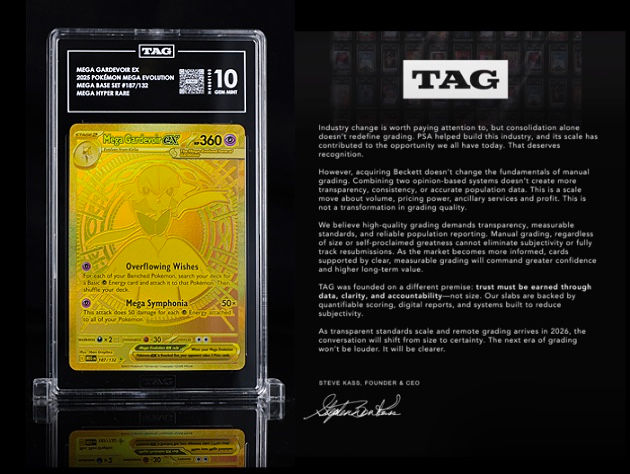
TAG Grading CEO Steve Kass ignited debate today with a bold Instagram post directly challenging industry giants PSA and Beckett, now consolidated under parent company Collectors.
“Combining two opinion-based systems doesn’t create more transparency, consistency, or accurate population data,” Kass wrote, framing TAG’s tech-driven model as the future of grading.
Yet collectors are divided: while some applaud Kass’s audacity to critique competitors, others accuse TAG of hypocrisy after raising bulk fees by 36% (mirroring PSA’s pricing) since April 2024. Meanwhile, PSA loyalists dismiss Kass’s critique as opportunism: “TAG is hiking fees faster than PSA did. This isn’t disruption—it’s imitation.”
As the grading wars escalate, one question looms: Can TAG’s vision of “measurable standards” survive its own profit-driven compromises?
TAG’s Vision: A New Era of Grading?
TAG CEO Steve Kass argues that the future of grading lies in data-driven objectivity: “Trust must be earned through data clarity and accountability—not size. Our slabs are backed by quantifiable scoring, digital reports, and systems built to reduce subjectivity.”
Unlike PSA’s opaque manual process, TAG uses proprietary algorithms to scan cards for defects, assigning grades based on measurable criteria like centering, surface wear, and corner sharpness. This tech-forward approach has won praise for its consistency and transparency—especially as PSA’s population report inaccuracies and grading controversies mount.
But Kass’s idealism clashes with TAG’s recent business decisions. While PSA and Beckett hiked fees to offset post-pandemic demand, TAG has followed suit: bulk grading fees rose from $14 to $19 per card in 2025 (they lowered down few days ago from $20), aligning with “market benchmarks” Kass critiques. “Industry change is worth paying attention to, but consolidation alone doesn’t redefine grading,” he states, even as TAG adopts PSA-like pricing strategies.
The Human Factor: TAG Isn’t Fully Automated
While TAG markets itself as a tech disruptor, human validation remains key. Algorithms flag flaws, but final grades require human oversight—a process that is not error-proof. For example, TAG’s team acknowledged cases of Gem Mint 10 grades where the software failed to spot dents on curved surfaces or subtle print defects. Recent forums have also highlighted instances of damaged cards and oversights, proving that “no system is flawless,” as TAG concedes, acknowledging the occasional errors that occur.
This reality clashes with CEO Steve Kass’s dismissal of manual grading: “Combining two opinion-based systems doesn’t create more transparency, consistency, or accurate population data.” Yet TAG’s hybrid model still leans on human input and judgment, blurring the line between innovation and traditional grading practices.
PSA, Beckett, and the Consolidation Debate
Kass reserves sharpest criticism for industry consolidation, particularly Collectors’ (PSA’s parent company) acquisition of Beckett: “This is a scale move about volume, pricing power, and profit—not a transformation in grading quality.” He’s right. PSA’s dominance lets it charge premium fees despite error-laden population reports.
But TAG’s fee hikes suggest it’s not immune to profit motives.
The Future of Grading: Loud Promises vs. Quiet Compromises
Kass envisions a “next era of grading” defined by “certainty over noise,” powered by remote grading tech and AI. But for now, TAG’s compromises—higher fees and human fallibility—mirror the industry’s struggle to align ideals with economics.
Conclusion: Can TAG Walk the Talk?
TAG’s vision of transparent, tech-driven grading is compelling, but its recent moves reveal a stark truth: No company—not even TAG—can fully escape the pull of profit or the limits of human oversight. Collectors must now weigh rising costs against TAG’s algorithmic precision and innovations like digital signature recognition (blocking slab resubmissions).
TAG has invested heavily in growth—$500K in equipment, 30+ staff, and expanded facilities earlier this year. While developing remote grading pods (which likely require human oversight), these ambitions risk straining finances. Such expansion demands a business model that prioritizes scalability without passing costs onto budget-conscious collectors.
For now, the grading wars rage on. And in this battle, consistency—not size—may yet be the ultimate victor.
Curious how grading giants like PSA, TAG, and SGC really operate? Dive into our new ‘Behind The Cards’ section, where we expose boardroom battles, expansion strategies, controversial fee hikes, frauds and the tech innovations reshaping authentication.
TAG CEO's Instagram post here.
Protect Your Collection With:
Disclosure: When you click or make a purchase through our links, we may earn a small percentage, which helps us maintain and improve our site.








Comments