


The Definitive 2002 Naruto Card Game Vintage Guide: Rookies & Grails

Updated: Aug 18

Drop back to lthe 13th December 2002: Maki no Ichi (Volume 1) hits the shelves, and the legendary Bandai NARUTO-ナルト- Card Game takes its very first step onto the tabletop battlefield! This is the absolute bedrock of Naruto TCG history, capturing the raw, unfiltered energy of the series' early days.
If you are hunting for true, day-one Japanese first-prints from this historic debut, you need to check the card's center-bottom margin. Look for the authenticating print string—the ultimate seal of approval:
© 岸本斉史 スコット/集英社・テレビ東京・ぴえろ 忍-X BANDAI 2002 MADE IN JAPAN With the upcoming takeover (finally) of the Naruto TCG by its original publisher Bandai soon, the highly anticipated release of the four new anime episodes by the end of 2026 to celebrate the franchise's 25th anniversary, and a rumored live-action movie in the making, the perfect storm is brewing.
The value of the foundational grails highlighted in this article is primed to do exactly what we witnessed with other legendary vintage TCG grails like Pokémon No Rarity and One Piece Hyperbattle—it’s straight to the moon, baby.
Today, we review what is considered a 'rookie' card for this TCG (the first official cards licensed by Bandai for the game and its promotion) and separately identify the first 'appearance' cards (early promotional releases from magazines and other media related strictly to the manga, rather than the anime or the TCG). Disclosure: We may earn a commission from qualifying purchases made through our links.
The Debut Expansion: Volume 1 (2002)
The official Naruto Card Game launched in December 2002 with its debut expansion, "Maki no Ichi" (Volume 1), which introduced a core set of 70 cards. Bandai distributed this inaugural set across three distinct product configurations tailored to retail outlets and vending systems:
Starter Box: A dedicated pre-constructed deck containing 40 cards, priced at 840 JPY (tax included).
Booster Pack: Standard retail foil packs containing 6 cards, priced at 158 JPY (tax included).
Carddass Booster: Coin-operated vending machine card strips dispensing a random assortment of 4 cards for 100 JPY (tax included).

Locating a pristine, original 2002 Volume 1 starter box or booster pack is exceptionally difficult today, causing sealed retail stock to command an immense market premium.
This valuation discrepancy stems directly from Bandai's distribution formats: cards pulled from coin-operated Carddass vending machines were highly prone to immediate surface scratching and edge chipping during mechanical dispensing. As a result, flawless, high-grade surviving copies sourced from the protective retail packaging are incredibly rare and heavily sought after by vintage collectors.
2. Core Mechanics & Categorization

The official Bandai Naruto Card Game relies on five core element symbols—Fire, Wind, Lightning, Earth, and Water—which players use to manage chakra costs and dictate deck building. Decks are structurally built around three foundational card types: Ninja (忍) characters used for combat, Jutsu (術) techniques used for tactical actions, and Mission/Strategy (作戦) cards that provide passive or active utility.
While the game features niche card types like Clients and rare movie-tie-in variants like Knights, the vast majority of the thousands of unique cards printed throughout the game's lifespan fall into these primary elemental and structural classifications.
3. The Rarity Engine & Pull Scarcity
The original Japanese Bandai print runs designate distribution scarcity directly via small, white circular ink dots printed on the bottom margin of the card face. According to cataloged checklist data, these markers denote standard box pull rates and distinct manufacturing finishes across the following rarity hierarchy:
No Dots (Normal): The baseline common-tier cards forming the core character roster and standard strategies, featuring flat, non-foil matte printing.
1 Dot (Rare): Mid-tier distribution cards. In early print blocks, these feature standard non-foil matte finishes, distinguished purely by their increased mechanical utility and standard text styling.
2 Dots (Super Rare): High-tier cards introducing premium holographic card faces. Depending on the release volume, these feature two distinct styles: traditional diagonal/horizontal stripe foils or later-era glitter/sparkle foil sheets.
3 Dots (Ultra Rare): The highest chase tier available within standard booster expansion packs, featuring highly distinctive foil finishes or gold text stamping treatments.
4 Dots (Promotional / Exclusive): A special maximum-tier designation reserved entirely for unique Promotional (PR) print runs, explicitly tracking event cards and inserts distributed outside standard retail booster boxes.
Early Japanese Tournaments & The Original Prize Ecosystem (2003)

Bandai officially inaugurated competitive play for the Naruto Card Game with a press release published on Friday, July 25, 2003. This announcement promoted a local storefront tournament circuit, starting with an event at a card shop in Sōka City, Saitama Prefecture, which quickly expanded into major simultaneous regional tournaments across Osaka, Tokyo, and Nagoya throughout August 2003.
Archival records from the official TV Tokyo tournament landing page reveal that early competitive prizing prioritized thematic merchandise rather than standard playable cards. The documentation explicitly lists "special mission completion certificates" alongside physical gaming supplies—such as official yellow Naruto card binders and red deck boxes—with no individual card prizes or card expansions indexed.
Crucially for vintage TCG historians, there is no documented evidence or official record indicating that stamped "Winner" character cards (such as localized tournament variants of Naruto or Sasuke) were produced or distributed during these initial 2003 Japanese tournament circuits.
4. The Definitive 2002 Naruto Rookie Cards
The term "Rookie"—originating from sports cards to define an athlete's first licensed card—has carried over to vintage TCGs. By this standard, a character's first appearance within a mainline, licensed retail set (excluding early non-TCG promotional items) qualifies as their true rookie asset. For Japanese collectors, the premier "Rookie" identity cards belong to the sequential Team 7 lineup and their sensei who kick off the Vol. 1 (巻ノ壱) retail checklist:
2002 Bandai Naruto CG Japanese Vol. 1 Uzumaki Naruto 1

The undisputed "Grail" entry of the game's identity. Instead of relying on lazy, recycled manga panels, Bandai swiped this illustration directly from Studio Pierrot's original character design sheets for the anime's October 2002 premiere episode. Raw copies from the true first print run have high velocity on secondary markets like Yahoo! Japan Auctions and Mercari, are now trading in between $200 to $500 for mint condition.
2002 Bandai Naruto CG Japanese Vol. 1 Sasuke Uchiha 2

This card represents the ultimate rookie card for Sasuke Uchiha in the Bandai Naruto Card Game. Released in December 2002 within the debut "Maki no Ichi" (Volume 1) expansion, this specific print carries the card identification number 忍-2 (Ninja-2), cementing it as the second official character card ever printed for the franchise. Featuring iconic early-series artwork of Sasuke wielding a kunai, this card is a foundational cornerstone for any vintage Naruto TCG collection.
2002 Bandai Naruto CG Japanese Vol. 1 Sakura Haruno 3

The final piece of the Genin trio highlights Sakura's original character profile blueprint. Custom-drawn by the animation staff to serve as the baseline standard for early 2002/2003 commercial merchandising, this asset captures her completely pristine before real field training ruined her gloves—making it an absolute nostalgia trip of a time capsule.
2002 Bandai Naruto CG Japanese Vol. 1 Kakashi Hatake 11

The elite Jōnin commander breaks the single-digit rookie sequence to round out the Team 7 hierarchy. Designated as a Rare (1 Dot) in the database, the artwork features Studio Pierrot's definitive early reference sheet illustration. The pose intentionally hides his left eye to tease his hidden Sharingan ability for the launch-era audience who hadn't yet seen him execute it in the anime. High-grade raw copies surface infrequently, holding a steep premium among dedicated character collectors.
The Grading Gap Note: While these standard matte cards hold immense nostalgic value, verified public grading data from PSA and comprehensive high-grade tracking for individual Japanese raw-card secondary sales from early 2002/2003 retail sets remain deeply fragmented due to the severe scarcity of surviving high-grade copies globally.
5. The Promotional Rookie & First Promo cards
Bandai's official PR (Promotional) series cards were distributed outside of booster packs as event or product inserts. They are easily identified by a "PR" code prefix and a "非売品" (Not for Sale) text stamp on the surface. Separately, the very first physical Naruto card ever printed was a promo included in an early Shonen Jump magazine; however, it has no gameplay stats and is entirely unrelated to the actual TCG.
2002 Bandai Naruto CG Japanese PR Uzumaki Naruto PR忍-1

This is the very first promotional card from the official TCG. Because it serves as the literal foundation of the entire promotional card infrastructure, clean raw Japanese copies are aggressively hoarded by franchise completionists. High-grade raw copies command exceptional liquidity on global secondary platforms like eBay, consistently pulling between $450 to $530 USD. Like the One Piece Luffy First Promo, we expect it to multiply drastically as we are approaching the 25th anniversary. The card's premium value is tied directly to its immense structural fragility, as the original stock is highly susceptible to severe edge chipping and surface silvering along the borders, making pristine surviving copies exceedingly rare. While the flyer version shown above is clearly its original first print, we have seen foil variations that come as well with different reference numbers like 'PR忍-1-R'. From a broad collector perspective, one could argue that historical value is king and first printings rule. However, current market trends for vintage items must also weigh the visual appeal and occasional scarcity of foil reprints.
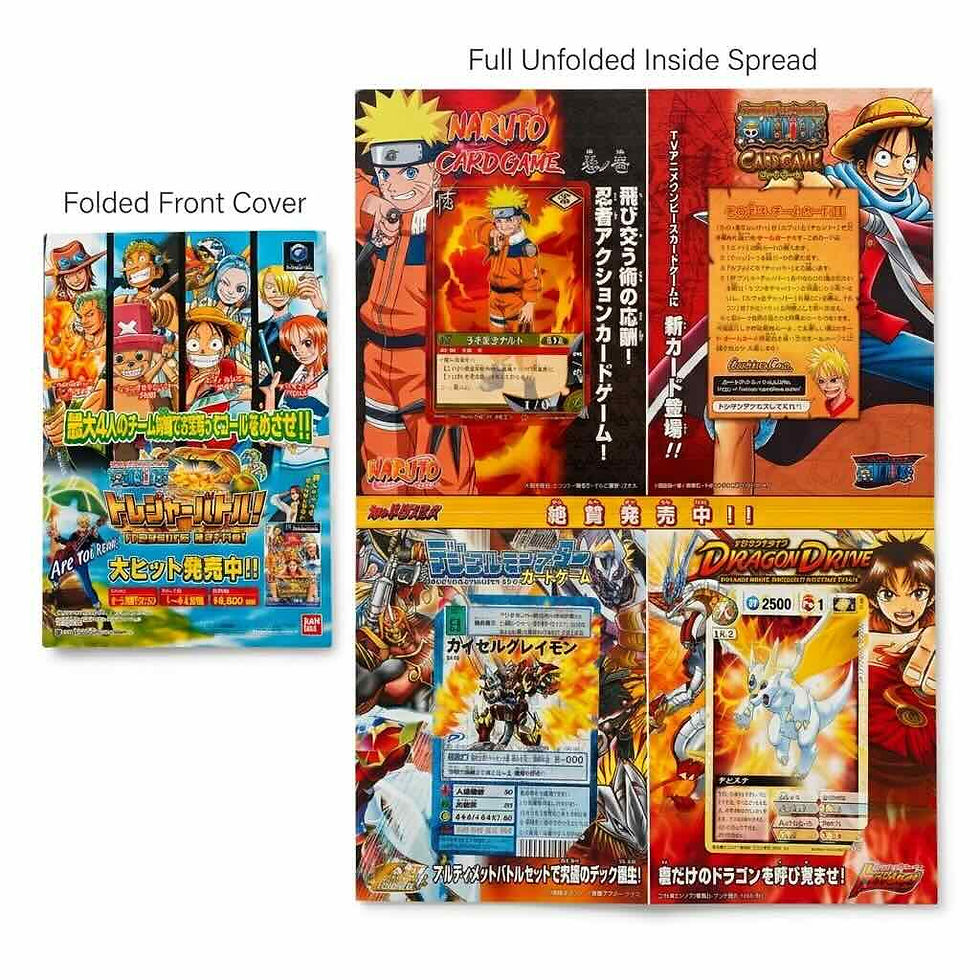
This historic price point is driven entirely by the card's status as the absolute chronological origin of the actual game mechanics, hitting the hands of Japanese collectors months before the first retail booster set (Volume 1) debuted in early 2003. This true first TCG promo was distributed exclusively as a peel-out promo sample inside a large, multi-franchise Bandai folding advertisement brochure distributed to attendees at Jump Festa 2003 (held in December 2002). Featuring One Piece: Treasure Battle on the folded front cover, opening the brochure reveals a massive inner spread containing Naruto's debut card alongside preview cards for Digimon and Dragon Drive:
2000 Shueisha Weekly Jump Illust. Collection Jump Festa 2001 Special WJ Naruto Card No. 14

This holy-grail collector's asset originates exclusively from the Jump Festa 2001 convention (December 2000), distributed by Shueisha as a limited-edition attendee giveaway. Holding immense historical significance, this promotional card was released nearly two full years before the official Naruto anime hit Japanese television in October 2002, and ahead of Bandai's first retail Trading Card Game set in 2003. So the card is not the first TCG promo, its front features Masashi Kishimoto's vintage, hand-drawn manga artwork of Naruto and Kakashi above the iconic "WEEKLY JUMP illust. collection" border. The reverse side features the official event logo, character bio, and its precise sequence identifier (No. 14). Pristine surviving copies are heavily hoarded by old-school franchise completionists and command top-tier premium pricing on global secondary markets.
2001 Jump Festa Naruto Calendar Card Illustration Promo

Following the first promotional cards which are non-TCG promo, like the iconic Naruto/Kakashi above, this calendar card was distributed exclusively at the very same historic Jump Festa 2001 event as well to promote the burgeoning manga.
Specifically, this piece belongs to the limited-edition "Illustration Card Collection" released during the convention. While utilizing Masashi Kishimoto's definitive artwork for Weekly Shonen Jump, its distinct functional design—featuring a calendar printed on the reverse side—highlights how Shueisha utilized varied marketing formats during the franchise's debut window. Recognizing these event-exclusive, non-TCG items is essential for capturing the complete timeline of earliest Naruto collectibles. A sleeper.
Conclusion: The Early Naruto Market Hierarchy
While the original Volume 1 Naruto rookie card remains the definitive market catalyst, the ultimate strategy lies in navigating the surrounding scarcity. Securing sealed starter boxes or boosters is the only viable route to flawless, high-grade copies, and while Card No. 14 surges from social media awareness, the Jump Festa 2001 calendar promo remains the premier sleeper target.
As this collectible market enters its infancy, securing early positions on the inaugural Super Rare and Ultra Rare holographic filters of main characters is the sharpest move before the broader market catches on.
Subscribe to the Slab-Z Weekly Newsletter
Stay ahead of the TCG & sports card market with graded card trends, rookie investment alerts, and exclusive industry insights—delivered straight to your inbox. Don’t miss updates that could turn your collection into gold.
Why wait? Knowledge is the ultimate gem mint. 🔍✨






Wow!!! Incredibly informative. Bravo. I can tell you know what you're talking about! Thanks for the article. It was beyond helpful!